Filtrar
22 Questões de concurso encontradas
Página 1 de 5
Questões por página:
Questões por página:
Concurso:
Prefeitura de Vitória - ES
Disciplina:
Inglês
The use of articles in English involves distinctions between "the" (definite) and "a/an" (indefinite), as well as sound-based rules for the use of "a" and "an". Consider the sentence: "___ sun rises in the east, and watching it from a mountain top is ___ unique experience." Choose the alternative that correctly fills the gaps.
Concurso:
Prefeitura de Vitória - ES
Disciplina:
Inglês
Os artigos em Língua Inglesa (Definido: *the*; Indefinidos: *a*/*an*) são determinantes que especificam ou generalizam um substantivo. O uso correto é notoriamente difícil para falantes de português, pois as regras diferem, especialmente quanto ao uso do artigo definido (*the*) com substantivos abstratos, genéricos ou nomes próprios, e a escolha entre *a* e *an* dependendo do som inicial da palavra seguinte.
Acerca do uso dos artigos em inglês, marque V, para as afirmativas verdadeiras, e F, para as falsas:
(__)O artigo indefinido "an" é usado antes de palavras que começam com som de vogal, independentemente da letra (e.g., *an hour*, *an umbrella*), enquanto "a" é usado antes de palavras com som de consoante (e.g., *a university*, *a car*).
(__)O artigo definido "the" é usado para especificar um substantivo que já é conhecido pelo leitor/ouvinte ou que é único em seu contexto (e.g., *The sun is hot*).
(__)Diferente do português, o artigo definido "the" geralmente não é usado antes de substantivos abstratos usados em sentido geral (e.g., *Love is important*, e não *The love is important*) ou nomes próprios de pessoas (e.g., *Mary lives here*, e não *The Mary lives here*).
(__)O artigo "a" é sempre usado antes de substantivos plurais para indicar generalização (e.g., *a books are expensive*).
Após análise, assinale a alternativa que apresenta a sequência correta dos itens acima, de cima para baixo:
Acerca do uso dos artigos em inglês, marque V, para as afirmativas verdadeiras, e F, para as falsas:
(__)O artigo indefinido "an" é usado antes de palavras que começam com som de vogal, independentemente da letra (e.g., *an hour*, *an umbrella*), enquanto "a" é usado antes de palavras com som de consoante (e.g., *a university*, *a car*).
(__)O artigo definido "the" é usado para especificar um substantivo que já é conhecido pelo leitor/ouvinte ou que é único em seu contexto (e.g., *The sun is hot*).
(__)Diferente do português, o artigo definido "the" geralmente não é usado antes de substantivos abstratos usados em sentido geral (e.g., *Love is important*, e não *The love is important*) ou nomes próprios de pessoas (e.g., *Mary lives here*, e não *The Mary lives here*).
(__)O artigo "a" é sempre usado antes de substantivos plurais para indicar generalização (e.g., *a books are expensive*).
Após análise, assinale a alternativa que apresenta a sequência correta dos itens acima, de cima para baixo:
Disciplina:
Inglês
mostrar texto associado
Visualizar Questão Comentada
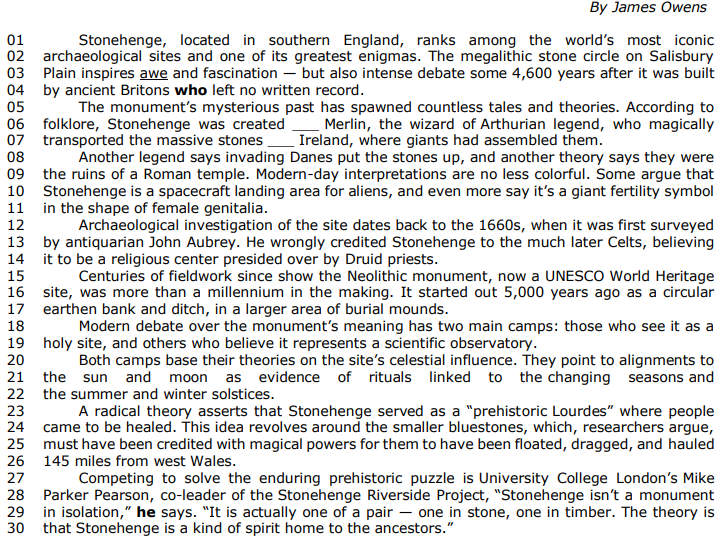
Analyze the following statements about the words “The megalithic stone” (l.02):
I. The article “the” is correct because it specifies a particular noun.
II. It would be grammatically correct to use “an” as a non-specific article because of the pronunciation rule.
III. It would be grammatically correct to use “a” as a non-specific article because of the pronunciation rule.
Which ones are correct?
I. The article “the” is correct because it specifies a particular noun.
II. It would be grammatically correct to use “an” as a non-specific article because of the pronunciation rule.
III. It would be grammatically correct to use “a” as a non-specific article because of the pronunciation rule.
Which ones are correct?
Concurso:
Prefeitura de Arapiraca - AL
Disciplina:
Inglês
mostrar texto associado
Consider the following fragment taken from paragraph 3.
“Some thought it would help tackle the scourge of drugs, while others saw it as an invasion of privacy”
Choose the sentence in which the indefinite article (a / an) has also been correctly used:
Mark the correct classifications, in order, of the determiners used in these sentences:
I - The car is parked outside; II - Her book is on the table; III - There are some apples on the counter.
I - The car is parked outside; II - Her book is on the table; III - There are some apples on the counter.
