Analise a imagem, leia o texto a seguir e responda à questão.
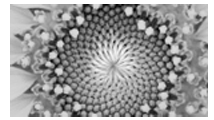
The seeds in a sunflower exhibit a golden spiral, which is tied to the Fibonacci sequence.
(Image credit: belterz/Getty Images)
The Fibonacci sequence is a series of numbers in which each number is the sum of the two that precede it. Starting at 0 and
1, the first 10 numbers of the sequence look like this: 0, 1, 1, 2, 3, 5, 8, 13, 21, 34, and so on forever. The Fibonacci sequence
can be described using a mathematical equation: Xn+2 = Xn+1 + Xn. People claim there are many special properties
about the numerical sequence, such as the fact that it is “nature’s secret code” for building perfect structures, like the Great
Pyramid at Giza or the iconic seashell that likely graced the cover of your school mathematics textbook. But much of that
is incorrect and the true history of the series is a bit more down-to-earth. The first thing to know is that the sequence is not
originally Fibonacci’s, who in fact never went by that name. The Italian mathematician who we call Leonardo Fibonacci was
born around 1170, and originally known as Leonardo of Pisa, said Keith Devlin, a mathematician at Stanford University. (...)
“Liber Abaci” first introduced the sequence to the Western world. But after a few scant paragraphs on breeding rabbits,
Leonardo of Pisa never mentioned the sequence again. In fact, it was mostly forgotten until the 19th century, when
mathematicians worked out more about the sequence’s mathematical properties. In 1877, French mathematician Édouard
Lucas officially named the rabbit problem “the Fibonacci sequence”, Devlin said. Other than being a neat teaching tool, the
Fibonacci sequence shows up in a few places in nature. However, it’s not some secret code that governs the architecture of
the universe, Devlin said.
It’s true that the Fibonacci sequence is tightly connected to what’s now known as the golden ratio, phi, an irrational number
that has a great deal of its own dubious lore. The ratio of successive numbers in the Fibonacci sequence gets ever closer to
the golden ratio, which is 1.6180339887498948482. The golden ratio manages to capture some types of plant growth, Devlin
said. For instance, the spiral arrangement of leaves or petals on some plants follows the golden ratio. Pinecones exhibit a
golden spiral, as do the seeds in a sunflower, according to "Phyllotaxis: A Systemic Study in Plant Morphogenesis"(Cambridge
University Press, 1994). But there are just as many plants that do not follow this rule.
Adaptado de: What “is the Fibonacci sequence”?, Deblin said | Live Science.
