Text 7
From EFL to ELF in Brazil: what the Brazilian education guidelines suggest.
At the beginning of the text devoted to English language teaching in the BNCC, it is made clear that the notion of an increasingly globalized, plural social world is fundamental to shed light on the relevance of learning the English language. According to the document,
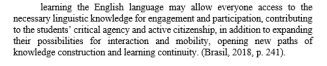
Based on this formative assessment, the BNCC lists three important functions of English language teaching (henceforward ELT): (1) to review the relations between language, territory and culture; (2) to broaden the understanding of literacy; and (3) to situate the English language in its lingua franca status.
Before delving into the first function of ELT, a brief, clear definition of English as a lingua franca (henceforward ELF) is necessary. Jenkins (2012, p.486) states that ‘it is a means of communication between people who come from different first language backgrounds.’ In this sense, any English speaker can be an ELF speaker, be they native users of English or not. She also adds that ‘ELF is not a language variety in the traditional sense of the term.’
The first ELT function described in the BNCC is in line with Jenkins’s view of ELF.
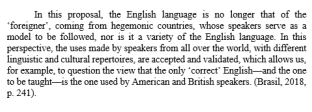
This quote argues that treating English as a lingua franca validates the uses of the language by speakers from places where English is neither the first language (L1) nor an official language, which is the case of Brazilian users of English. The BNCC also contributes to the ownership debate concerning the English language, which has been brought to the fore by Widdowson (1994), who points out that native speakers of English who live in the US or the UK no longer ‘own’ the language. Given the fact that English has become an international language, he argues that ‘no nation can have custody over it’ (Widdowson,1994, p.385).
FRANCO, C. P. Teaching English as a Lingua Franca in Brazil: insights into materials writing. In: International Journal of English Linguistics; Vol.11, No.3; 2021. P.62-63
