Questões de Concurso
Filtrar
3.862 Questões de concurso encontradas
Página 305 de 773
Questões por página:
Os N-IDS ou Sistemas de Detecção de Intrusão baseados em Redes utilizam métodos para informar e bloquear as intrusões. Considere os métodos abaixo.
I. Reconfiguração de dispositivos externos: um comando é enviado pelo N-IDS a um dispositivo externo (com um filtro de pacotes ou um firewall) para que se reconfigure imediatamente e possa bloquear uma intrusão. Esta reconfiguração é possível através do envio de dados que expliquem o alerta (no cabeçalho do pacote).
II. Envio de um trap SMTP a um supervisor externo (armadilha SMTP): é enviado um alerta (e detalhes dos dados envolvidos) em forma de um datagrama SMTP para um console externo.
III. Registro (log) do ataque: cria um backup dos detalhes do alerta em um repositório, incluindo informações como o registro da data, o endereço IP do intruso, o endereço IP do destino, o protocolo utilizado e a carga útil.
IV. Armazenamento de pacotes suspeitos: os pacotes originais capturados e/ou os pacotes que desencadearam o alerta são guardados.
V. Envio de um ResetKill: construção de um pacote de alerta IP para forçar o fim de uma conexão (válido apenas para as técnicas de intrusão que utilizam o protocolo de aplicação IP).
Estão corretos os métodos
A figura abaixo apresenta uma arquitetura de rede com firewall. DMZ refere-se a uma DeMilitarized Zone ou zona desmilitarizada.
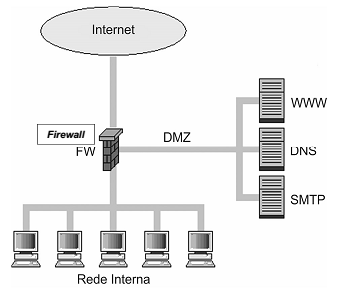
Um Técnico, observando a figura, afirma corretamente que
The purpose of most backup policies is to create a copy of data so that a particular file or application may be restored after data is lost, corrupted, deleted or a disaster strikes. Thus, backup is not the goal, but rather it is one means to accomplish the goal of protecting data. Testing backups is just as important as backing up and restoring data. Backup applications have long offered several types of backup operations. Two of the most common backup types are described below.
I. This operation will result in copying only the data that has changed since the last backup operation of any type. The modified time stamp on files is typically used and compared to the time stamp of the last backup. Backup applications track and record the date and time that backup operations occur in order to track files modified since these operations. Because this backup will only copy data since the last backup of any type, it may be run as often as desired, with only the most recent changes stored.
II. This type of backup makes a copy of all data to another set of media, which can be tape, disk or a DVD or CD. The primary advantage to performing this backup during every operation is that a complete copy of all data is available with a single set of media. This results in a minimal time to restore data, a metric known as a Recovery Time Objective (RTO).
The backup types I and II are, respectivelly,
Consider the statements below.
I. It is defined as a procedure requiring the combination of several factors, including at least two of the following: Knowledge-something the user knows, e.g., a password, a personal identification number (PIN); Ownership-something the user has, e.g., token, smart card, mobile phone/SIM; Inherence − something the user is, e.g., fingerprint. It is worth highlighting that the aforementioned requirement of having mutually independent factors could be difficult to match. In fact, in the context of access to Internet services, when using ownership and inherence factors as well as when inputting a PIN or password, the user transmits digital data to the verifying counterpart, so that regardless of the generating factor, susceptibility to interception is a common vulnerability.
II. Security administration can be costly and prone to error because administrators usually specify access control lists for each user on the system individually. With this kind of control, security is managed at a level that corresponds closely to the organization's structure. Each user is assigned one or more roles, and each role is assigned one or more privileges that are permitted to users in that role. Security administration with it consists of determining the operations that must be executed by persons in particular jobs, and assigning employees to the proper roles. Complexities introduced by mutually exclusive roles or role hierarchies are handled by its software, making security administration easier.
The statements I and II refers respectively to
