Questões de Concurso
Filtrar
1.285.803 Questões de concurso encontradas
Página 1504 de 257.161
Questões por página:
Questões por página:
De acordo com Bohumil Med, o acento métrico é constituído pelas acentuações fortes e
fracas dos tempos dos compassos, não sendo grafado na partitura. Analise as assertivas a
seguir acerca do tempo métrico:
I – O tempo forte é chamado de impulso e o tempo fraco é chamado de apoio;
II – No compasso quaternário, o primeiro tempo é forte, o segundo tempo é meio forte, o terceiro tempo é forte e o quarto tempo é fraco;
III – No compasso ternário, o primeiro tempo é forte, o segundo tempo é forte e o terceiro tempo é fraco;
IV – Os compassos compostos têm a mesma acentuação métrica dos compassos simples, em relação aos tempos.
Estão corretas as assertivas:
I – O tempo forte é chamado de impulso e o tempo fraco é chamado de apoio;
II – No compasso quaternário, o primeiro tempo é forte, o segundo tempo é meio forte, o terceiro tempo é forte e o quarto tempo é fraco;
III – No compasso ternário, o primeiro tempo é forte, o segundo tempo é forte e o terceiro tempo é fraco;
IV – Os compassos compostos têm a mesma acentuação métrica dos compassos simples, em relação aos tempos.
Estão corretas as assertivas:
Read the comic strip:
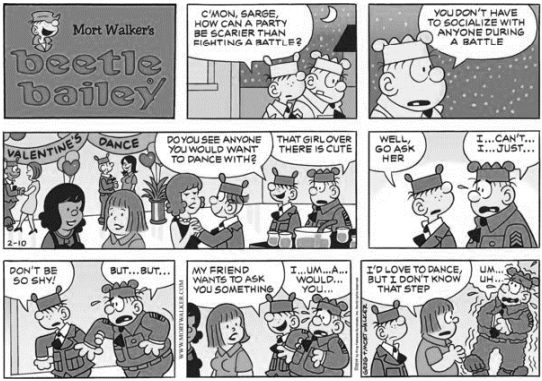
WALKER, M.; WALKER, G. Beetle Bailey. Disponível em: https://www.arcamax.com. Acesso em: 03 set. 2024.
The sentence “That girl over there is cute” shows an example of a feminine noun. Choose the option that correctly shows masculine and feminine equivalent nouns.
mostrar texto associado
The underlined words in Text 1 are prepositions. About this topic, judge the statements
below as true (T) or false (F).
I) The preposition “from” in the second paragraph indicates origin or source. ( )
II) The preposition “in” in the second paragraph is also used for cities and countries. ( )
III) The preposition “on” in the second paragraph is also used for seasons and months. ( )
IV) The preposition “in” in the fourth paragraph is also used for days of the week. ( )
V) The fragment “depends on” in the third paragraph could correctly be replaced with “depends of”. ( )
I) The preposition “from” in the second paragraph indicates origin or source. ( )
II) The preposition “in” in the second paragraph is also used for cities and countries. ( )
III) The preposition “on” in the second paragraph is also used for seasons and months. ( )
IV) The preposition “in” in the fourth paragraph is also used for days of the week. ( )
V) The fragment “depends on” in the third paragraph could correctly be replaced with “depends of”. ( )
mostrar texto associado
Analyze the statements about the fragments in uppercase letters in Text 1, then choose the
correct option.
I – All of the fragments in uppercase letters are examples of the Simple Past tense.
II – All of the fragments in uppercase letters refer to past actions in some way.
III – In “have initiated”, the verb tense refers to a recent action at the time the news was written.
IV – None of the fragments in uppercase letters contain a past participle form.
V – The verb “created” is used in this verb tense because it refers to a past action in a specific time.
I – All of the fragments in uppercase letters are examples of the Simple Past tense.
II – All of the fragments in uppercase letters refer to past actions in some way.
III – In “have initiated”, the verb tense refers to a recent action at the time the news was written.
IV – None of the fragments in uppercase letters contain a past participle form.
V – The verb “created” is used in this verb tense because it refers to a past action in a specific time.
Choose the correct use of the infinitive or gerund to complete the dialogue.
NCO Academy student: Good morning, Sir
Sergeant Major: Why are you awake in uniform so early? Today is your day off. You can ___(sleep)___ until seven o’clock today. It’s worth ___(stay)___ in bed a little longer to recover from the exhausting week.
NCO Academy student: I enjoy ___(learn)___ foreign languages, so I woke up early ___(study)___ English.
Sergeant Major: I’m really proud of ___(see)___ you working so hard.
NCO Academy student: Good morning, Sir
Sergeant Major: Why are you awake in uniform so early? Today is your day off. You can ___(sleep)___ until seven o’clock today. It’s worth ___(stay)___ in bed a little longer to recover from the exhausting week.
NCO Academy student: I enjoy ___(learn)___ foreign languages, so I woke up early ___(study)___ English.
Sergeant Major: I’m really proud of ___(see)___ you working so hard.
