Questões de Concurso
Filtrar
734.789 Questões de concurso encontradas
Página 5306 de 146.958
Questões por página:
Questões por página:
From a sociocultural perspective (Vygotsky, 1978),
human cognition is a dynamic phenomenon that
originates in social activity and is deeply situated in
physical and social contexts. Within this framework,
learning an additional language is not viewed as the
simple internalization of grammatical rules transmitted
from the outside into the learner’s mind. Instead, it is
conceived as an interpsychological phenomenon before
it can become intrapsychological. In other words,
intersubjectivity must necessarily precede intrasubjectivity
in the language learning process.
Considering this sociocultural approach to language acquisition, choose the alternative that correctly characterizes how students learn English in the classroom.
Considering this sociocultural approach to language acquisition, choose the alternative that correctly characterizes how students learn English in the classroom.
Teaching a foreign language involves providing students with interpretative procedures for meaning-making and distinct world perceptions, regardless of their
level of proficiency. Within this framework, the
teacher acts as an intercultural mediator, encouraging
students to critically reflect on how cultures and identities are socially constructed within unequal power
structures.
Considering the concept of intercultural mediation, choose the alternative that presents a pedagogical practice aligned with this critical perspective.
Considering the concept of intercultural mediation, choose the alternative that presents a pedagogical practice aligned with this critical perspective.
According to Vygotsky (1987), conceptual development
relies on the dialectical integration between scientific
concepts (formal school instruction) and everyday
concepts (informal social interaction). Therefore,
teaching language rules in isolation does not lead to
development; instead, formal knowledge must connect
to students’ empirical experiences and real-world
applications. Analyze the three statements below
regarding how language learners develop and integrate
scientific and everyday concepts in the classroom.
I - Scientific concepts are not learned through mere words or rote memory; rather, their genuine assimilation by the student depends on their convergence with everyday concepts, which provide real-world meaning to formal structures.
II - Language instruction that isolates scientific concepts from the student’s reality leads to mechanical learning and empty verbalism, producing abstract knowledge that the student is usually unable to apply or connect to real-world situations.
III - Language teaching that relies on everyday concepts allows students to easily transfer their linguistic knowledge to new, unexperienced contexts, as spontaneous learning automatically grants conscious and voluntary control over abstract grammatical rules.
Which statements are aligned with Vygotsky’s view?
I - Scientific concepts are not learned through mere words or rote memory; rather, their genuine assimilation by the student depends on their convergence with everyday concepts, which provide real-world meaning to formal structures.
II - Language instruction that isolates scientific concepts from the student’s reality leads to mechanical learning and empty verbalism, producing abstract knowledge that the student is usually unable to apply or connect to real-world situations.
III - Language teaching that relies on everyday concepts allows students to easily transfer their linguistic knowledge to new, unexperienced contexts, as spontaneous learning automatically grants conscious and voluntary control over abstract grammatical rules.
Which statements are aligned with Vygotsky’s view?
According to Rajagopalan (2009), up to three-quarters
of global English users are non-native speakers.
Therefore, pedagogical practices must reject the
"native speaker myth" and the pursuit of a "perfect
pronunciation" - concepts that reinforce unequal power
relations. Instead, additional-language classrooms
should value multiple linguistic varieties, prioritizing
intelligibility, identity, and the negotiation of meaning.
Considering pedagogical practices aimed at valuing different linguistic varieties in the classroom, choose the alternative that presents an activity aligned with this perspective.
Considering pedagogical practices aimed at valuing different linguistic varieties in the classroom, choose the alternative that presents an activity aligned with this perspective.
mostrar texto associado
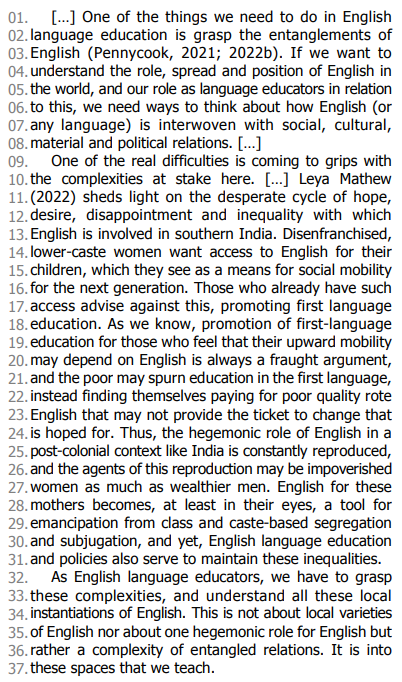
“These spaces” (l. 37) in “It is into these spaces that
we teach” (l. 36-37) refers to
